The full original slide deck is at the end of this page.
How Overseas PhD Students Can Cope with Mental Health Challenges
Miao Yu · Institut de Physique du Globe de Paris (IPGP)
Berlin & Brandenburg Chinese Scholars Association · Jan 15, 2022
01 · The State of Overseas Students' Mental Health
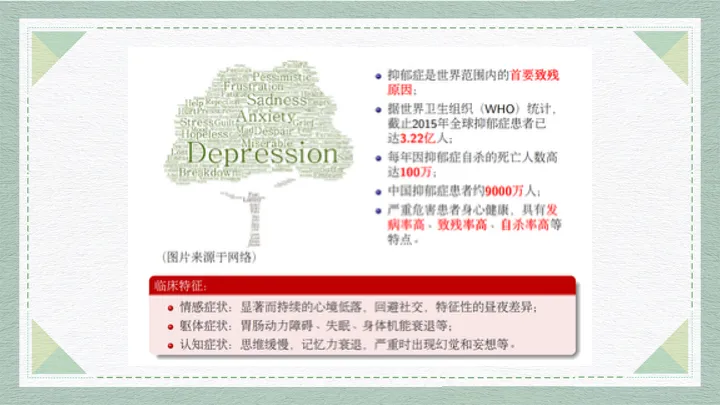
Individual experiences vary widely, but the struggles of a group share a common root. A single, isolated case might be attributed to unique circumstances — but when suicides recur across a highly educated population, we have to ask: what's actually going wrong?
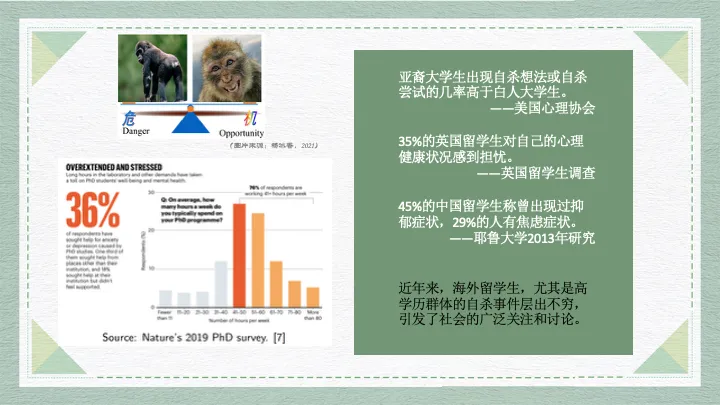
- Asian college students report suicidal ideation or attempts at higher rates than white college students. — American Psychological Association
- 35% of UK international students report concerns about their own mental health. — UK international student survey
- 45% of Chinese international students reported depressive symptoms, and 29% reported anxiety symptoms. — 2013 Yale University study
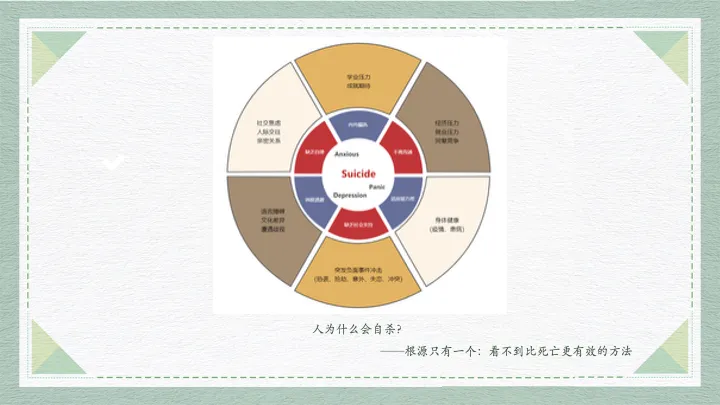
Why do people take their own lives? — There's really only one root cause: they can no longer see a way out that feels more viable than death.
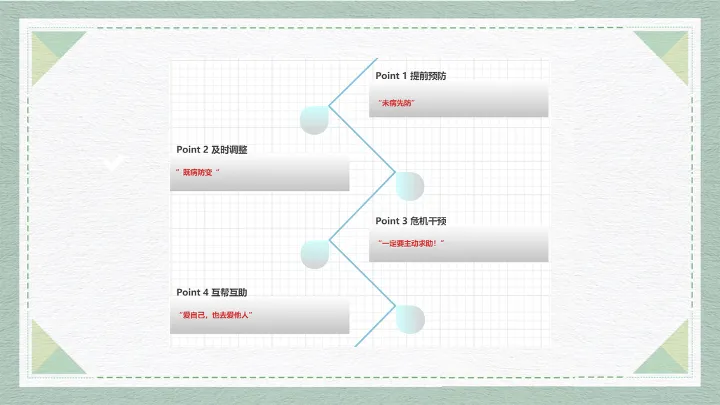
02 · "Prevent Illness Before It Arises"
"The best physician treats illness before it appears; the mediocre physician treats it as it emerges; the inferior physician treats it only after it has taken hold." — Sun Simiao (Tang dynasty)
03 · Coping with Negative Emotions
"In fighting the enemy, we must despise the enemy strategically, but take the enemy fully seriously tactically." (Selected Works of Mao Zedong, Vol. 7, p. 328)
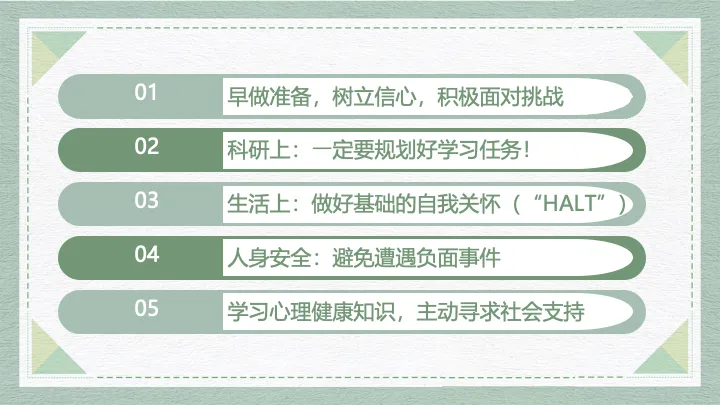
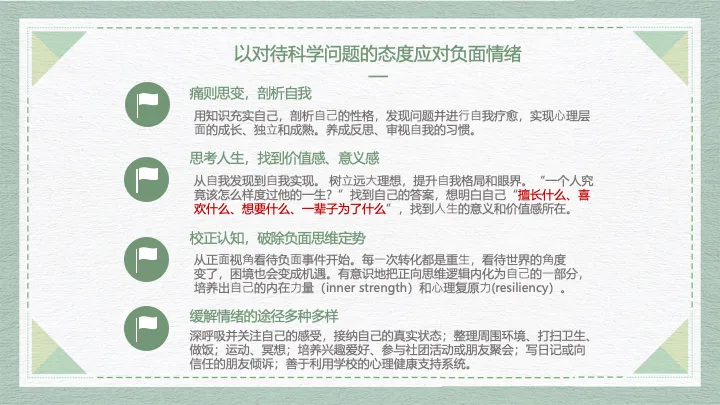
Treat negative emotions the way you'd treat a scientific problem — build up your own knowledge, examine your own personality, identify the issue and work through it, and let that process drive psychological growth, independence, and maturity; make a habit of reflecting on and examining yourself.
Think through what your life is for, and find a sense of worth and meaning — move from self-discovery to self-actualization, set ambitious goals, and widen your own perspective. Get clear on what you're good at, what you enjoy, what you actually want, and what you're ultimately working toward — that's where a sense of meaning and self-worth comes from.
Correct distorted thinking and break fixed negative thought patterns — look at negative events from a more constructive angle, internalize positive reasoning as part of who you are, and build inner strength and resiliency.
There's no single way to ease difficult emotions: breathe deeply and pay attention to how you actually feel, tidy your physical surroundings, exercise or meditate, cultivate a hobby, keep a journal or talk to someone you trust, and make good use of your university's mental health support services.
04 · Crisis Intervention
"Before the psychology of suicide takes hold, the person does not actually want to die — they want to survive. That will to survive is, in fact, unusually intense." — "On Not Committing Suicide," Mao Zedong
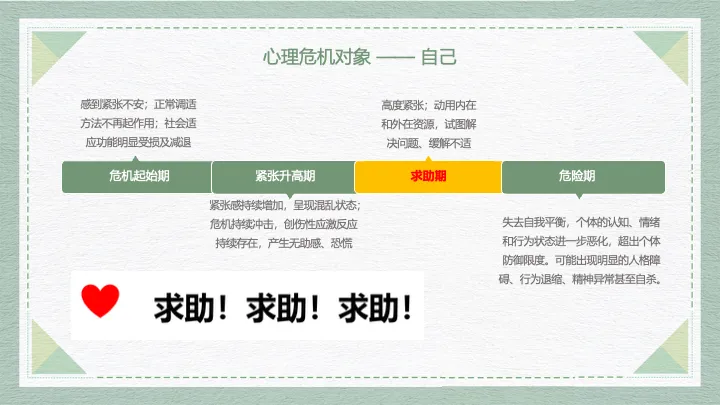
A psychological crisis generally unfolds in four stages: an onset stage (a growing sense of unease, as usual coping strategies stop working) → an escalation stage (sustained pressure produces helplessness and panic) → a help-seeking stage (the person draws on internal and external resources to try to resolve it) → a danger stage (defenses give way, which can lead to withdrawal or even suicide).
Drawing on real cases, the talk examined the makeup of suicide risk among overseas PhD students across several dimensions — personality, family relationships, social factors, the research environment, and gender (see the five case analyses in the original slides at the end of this page).
Mutual Support, Starting With Yourself
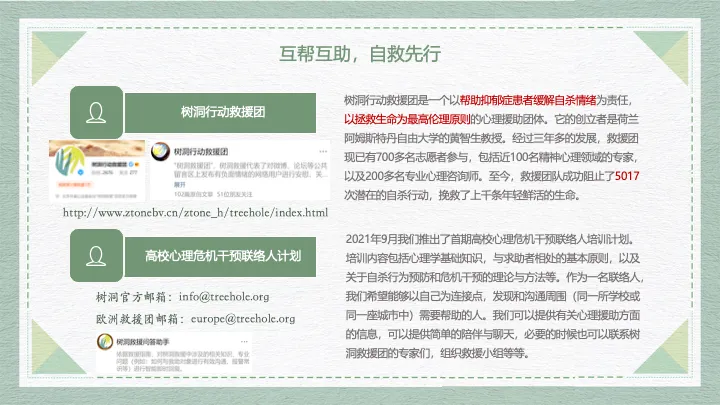
Tree Hole Rescue is a mental-health support group whose mission is to help people with depression through suicidal crises, guided by the principle that saving a life comes above all else; it was founded by Zhisheng Huang, a professor at Vrije Universiteit Amsterdam. It has since grown to more than 700 volunteers, including close to 100 psychiatry and psychology specialists and over 200 professional counselors, and has intervened in more than 5,000 potential suicide attempts.
University Mental Health Crisis Intervention Liaison Program: launched its first cohort in September 2021, covering foundational psychology, principles for engaging with someone in distress, and theory and methods for suicide prevention and crisis intervention. As a liaison, the goal is to act as a connection point — to notice and reach the people around you who need help, offer basic information and companionship, and, when needed, bring in Tree Hole Rescue's specialists and organize an intervention team.
Full slide deck