Estimation of Apparent Surface Wave Q-Value on Mars Using the Marsquake Event S1222a
Yuan, D., Yu, M., Meng, H., et al. — Journal of Geophysical Research: Planets, 2026
In Preparation
Abstract
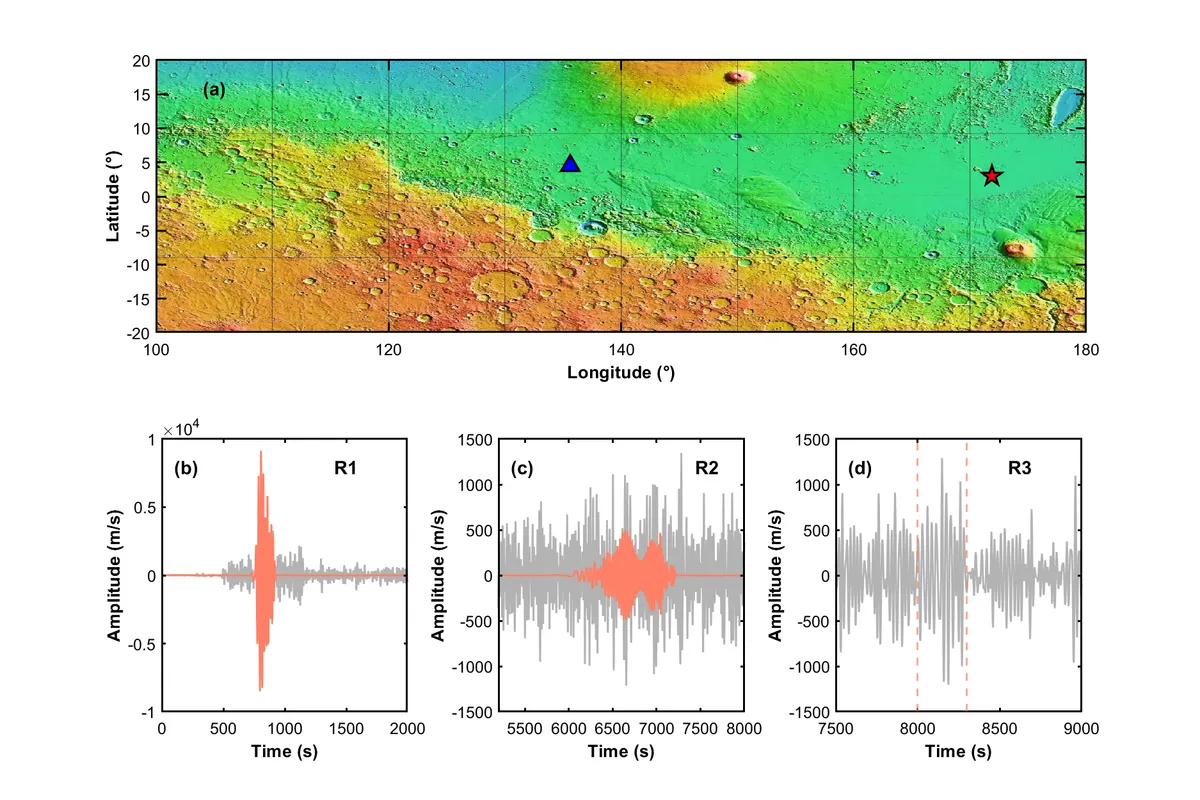
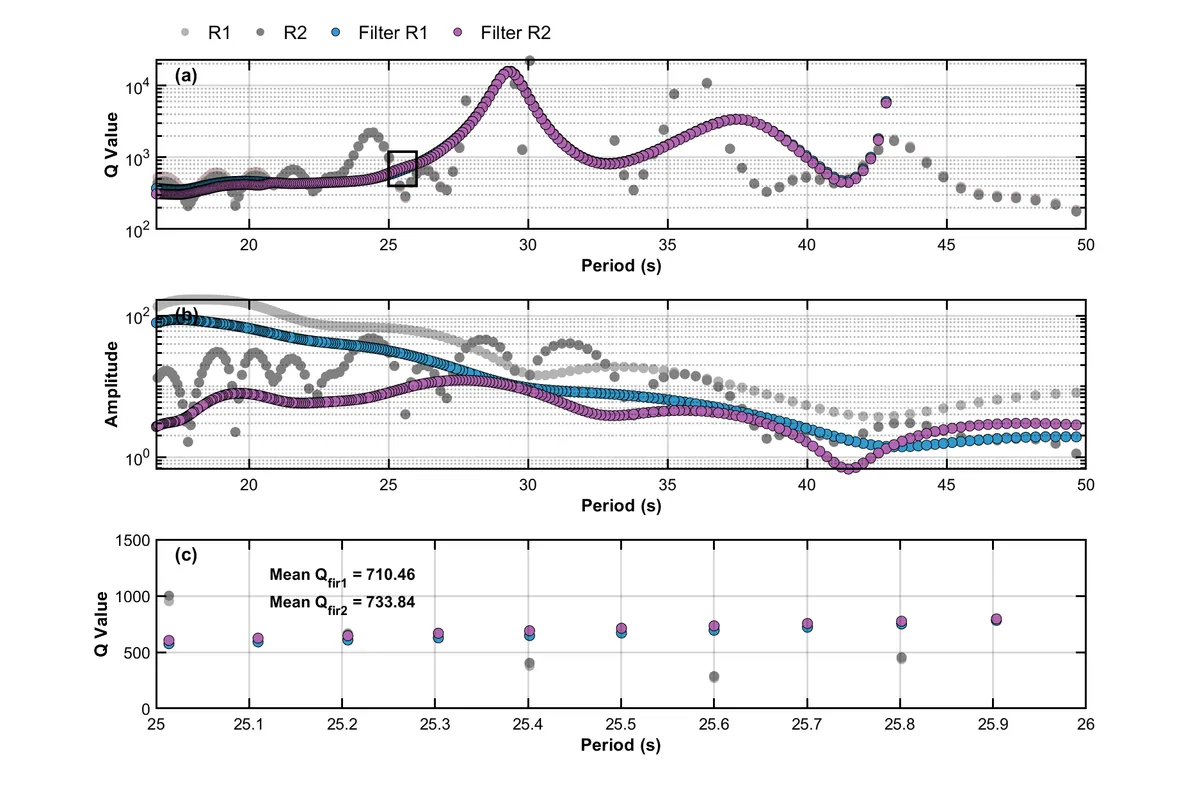
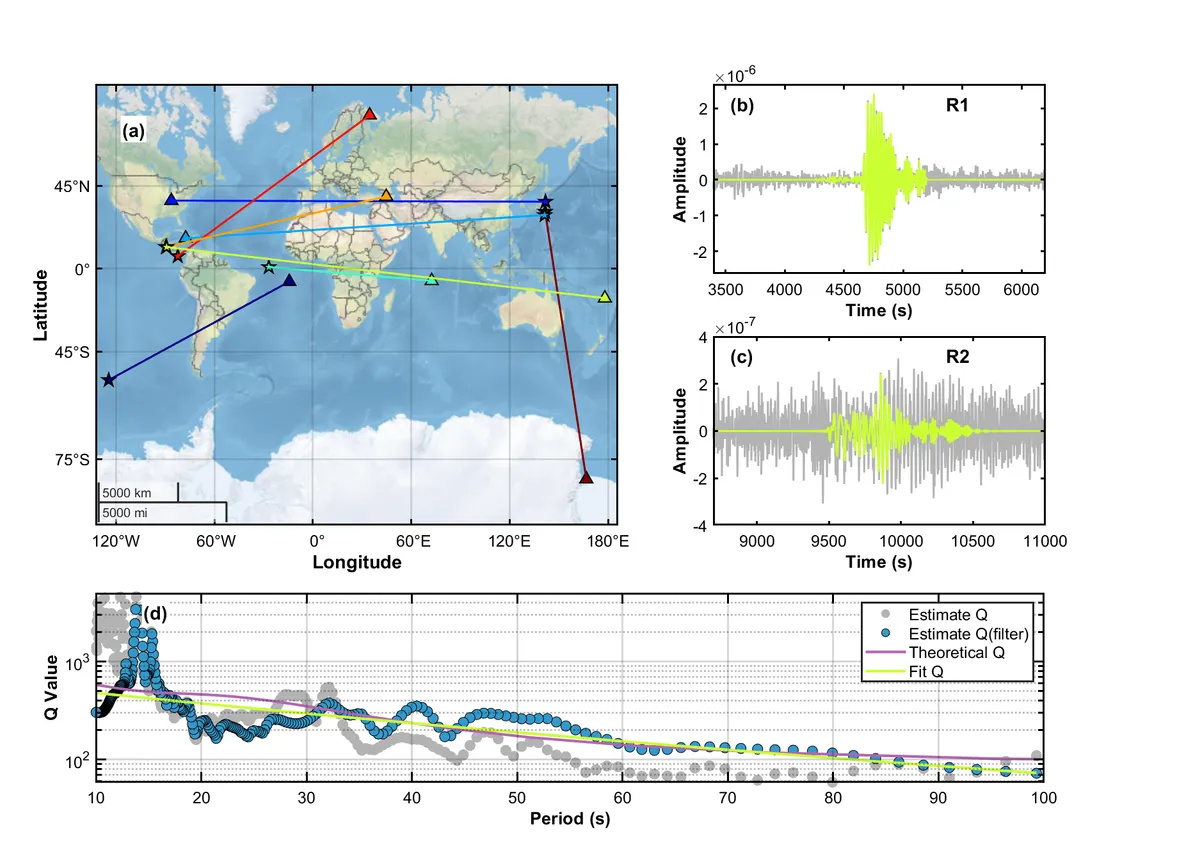
Mars is the terrestrial planet most analogous to Earth, and constraints on its seismic attenuation (quality factor Q) inform the composition, thermal state, and water content of its crust and mantle. The marsquake S1222a, recorded by NASA's InSight mission, is the largest Martian seismic event detected to date and the first on which Rayleigh and Love surface waves have been distinctly identified. Using the multi-orbit Rayleigh waves R1 and R2 of S1222a in the 0.02-0.06 Hz band, we apply phase-matched filtering and an R1/R2 amplitude-ratio method to estimate the apparent surface-wave Q of the shallow Martian crust, first validating the approach on Earth's AK135 velocity model and terrestrial seismic records. For the Martian data, within the 25.0-26.0 s period window, we obtain averaged apparent Q values of 710 (from R1) and 734 (from R2); comparative tests on the R2 sub-phases yield consistent results. These apparent Q values imply an intrinsic attenuation factor exceeding 734 at 25-26 s periods, an attenuation level between that of Earth and the Moon and consistent with prior coda-wave studies. By exploiting multi-orbit surface waves, this amplitude-ratio method mitigates the limitations of single-station observation and offers new seismological constraints on the internal structure and water content of Mars.
Status: In preparation; targeting Journal of Geophysical Research: Planets. Not yet submitted.
Contribution: Co-author. Responsible for data analysis and manuscript writing and revision.
Significance: Planetary seismology represents the frontier of geophysical research. This study extends Earth-based seismic attenuation methods to another planet, demonstrating the generalizability of geophysical inversion frameworks and contributing to NASA InSight mission science.
Figures