Distributed Acoustic Sensing Reveals Structural Reinforcement of an Earthfill Dam after Curtain Grouting
Yu, M., Liu, P., Meng, H., et al. — Earthquake Science, 2026
Under Revision
Abstract
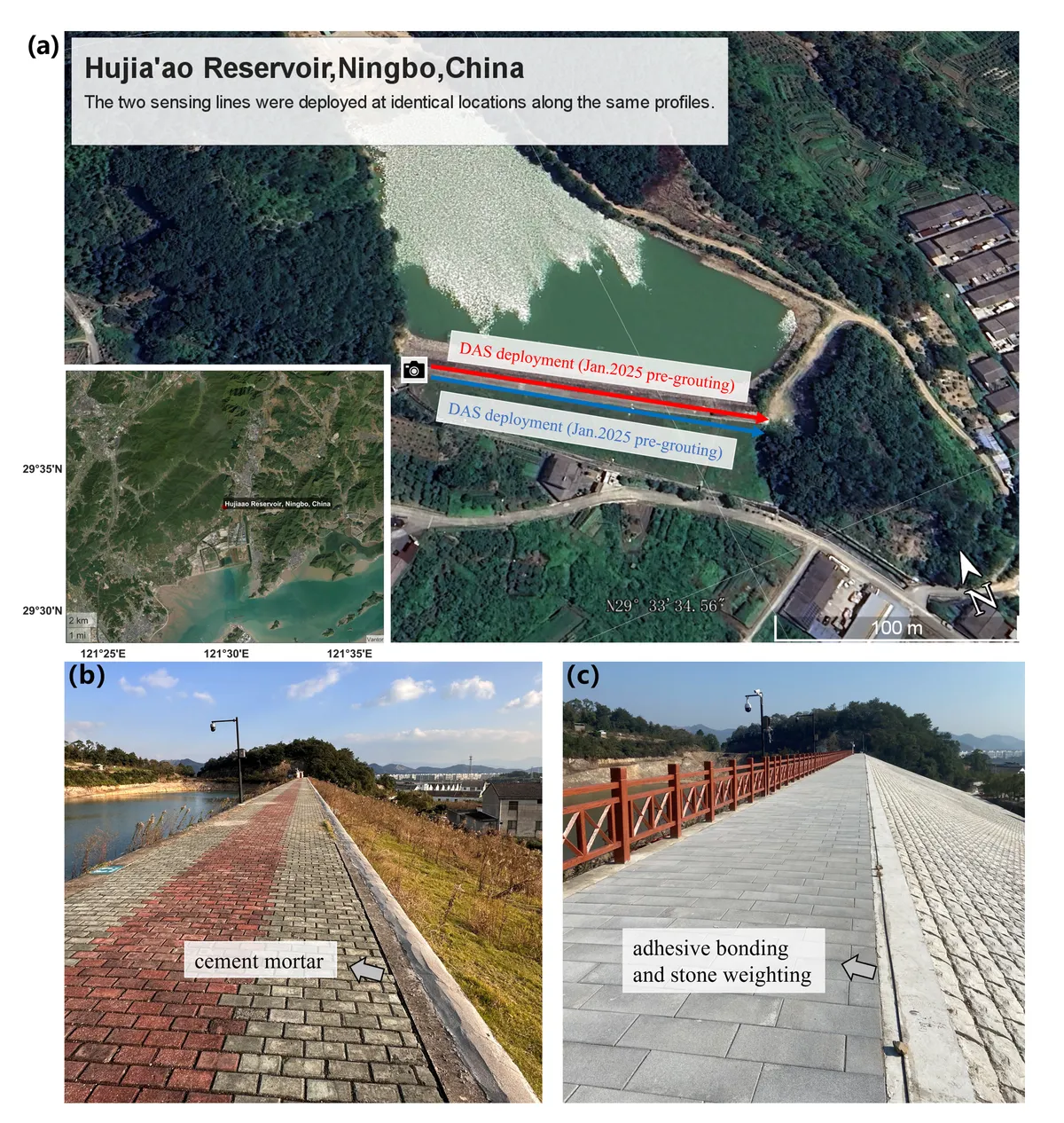
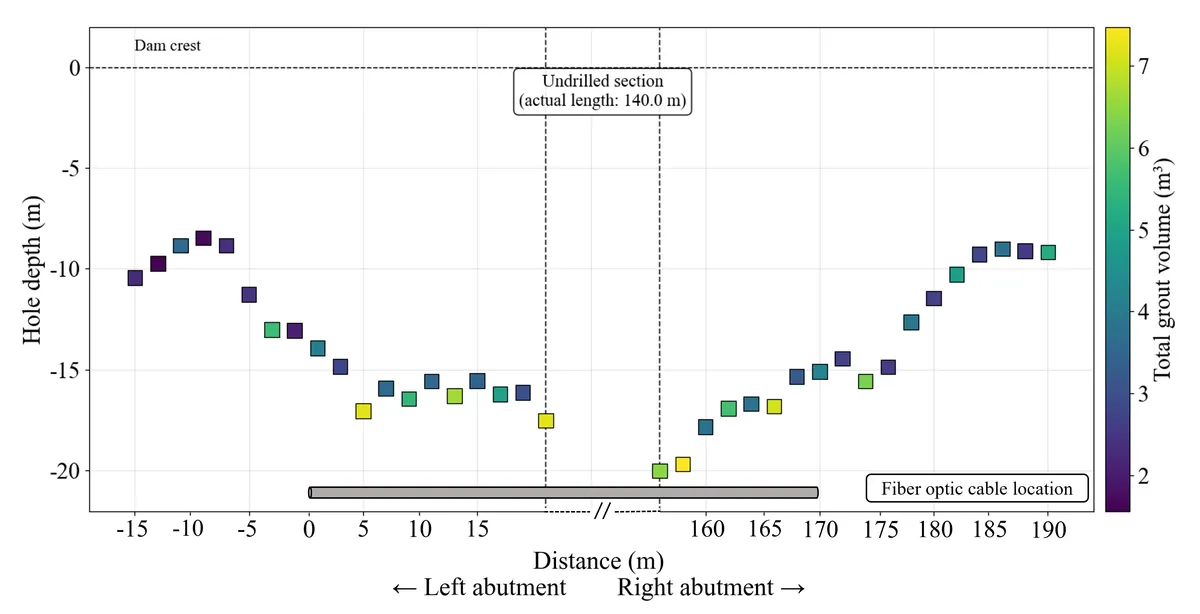
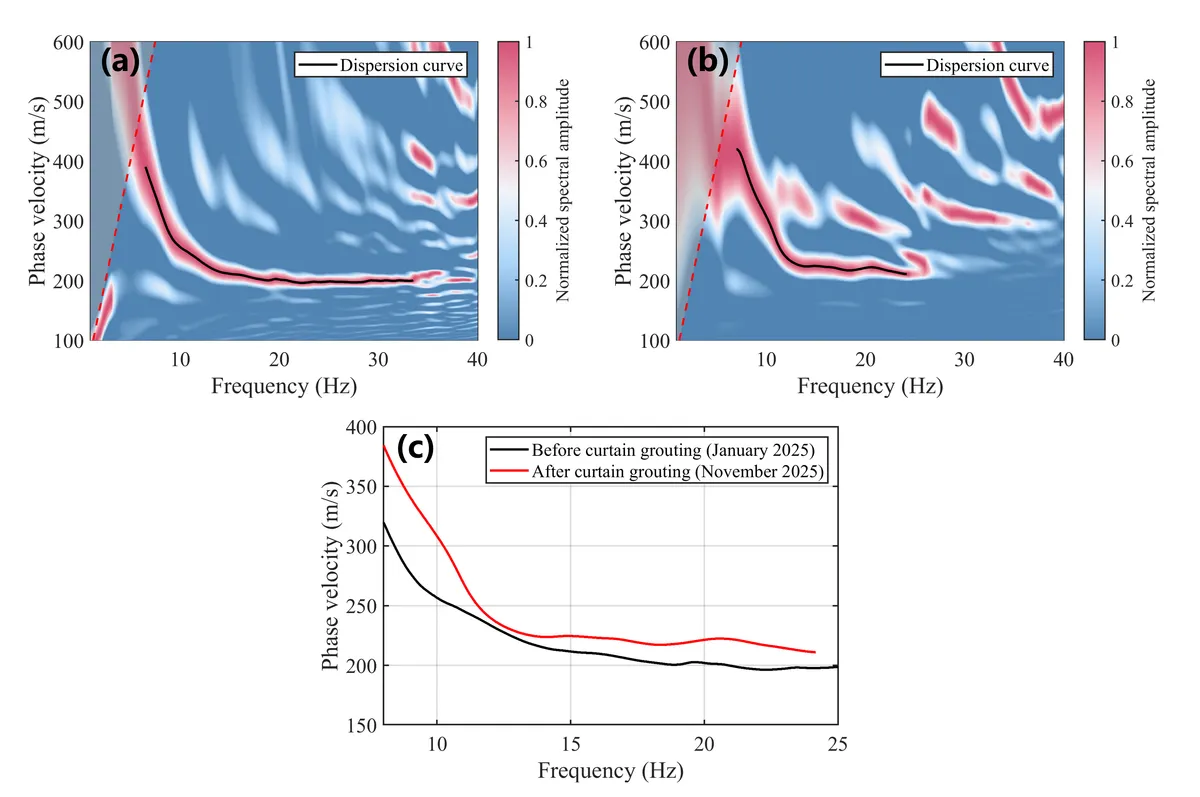
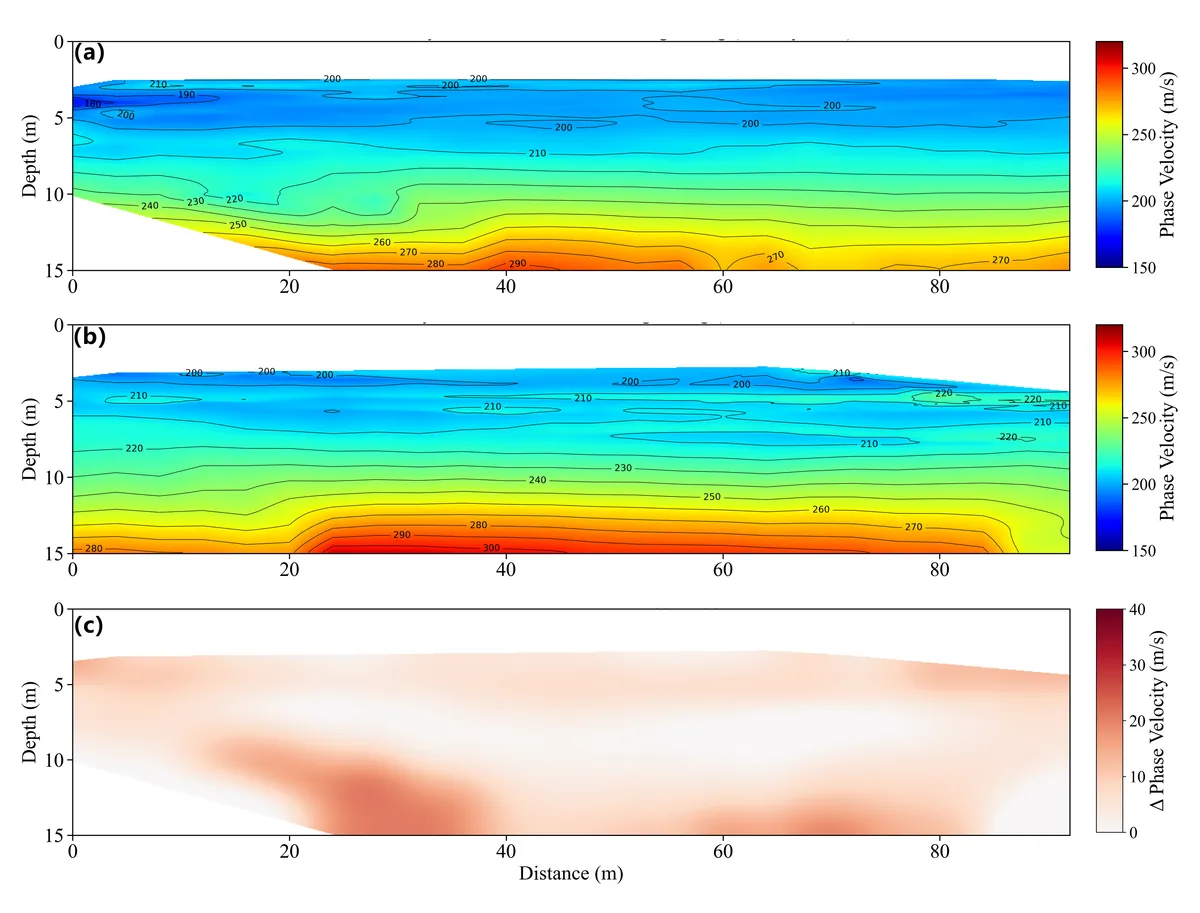
Aging earthfill dams require reliable monitoring to evaluate the effectiveness of remediation measures such as seepage-control grouting. We use Distributed Acoustic Sensing (DAS) to investigate structural changes in an earthfill dam before and after curtain grouting, recording ambient and traffic-induced wavefields along the dam crest in two surveys. Combining ambient-noise interferometry with diffuse-wave screening, we retrieve stable empirical Green's functions from short recordings and extract Rayleigh-wave dispersion via a frequency-Bessel transform, mapping phase velocity to depth with the half-wavelength approximation. Autocorrelation and waveform-stretching analyses independently corroborate the results. Post-grouting surveys show a systematic 10-20 m/s increase in shallow Rayleigh-wave phase velocities with reduced lateral heterogeneity, indicating increased near-surface stiffness and grout migration beyond the immediate vicinity of the injection boreholes. The results establish DAS combined with ambient-noise interferometry as a practical, non-invasive tool for monitoring structural evolution and remediation effectiveness in earthfill dams.
Status: Submitted to Earthquake Science in March 2026; currently addressing the first round of reviewer comments (received June 2026).
Contribution: Co-first author. Led DAS data processing, ambient-noise interferometry and diffuse-wave screening, frequency-Bessel dispersion analysis, and the autocorrelation/stretching validation used to cross-check the pre- versus post-grouting velocity changes.
Significance: This work represents a pioneering application of distributed acoustic sensing to dam structural health monitoring — bridging fiber-optic sensing technology with ambient-noise seismic imaging to enable continuous, high-spatial-resolution evaluation of remediation effectiveness. The study directly contributes to critical infrastructure protection at scale.
Figures