Science Explainer · Wed, Apr 1, 2026
Can the Ground Hear Your City?
Miao YU
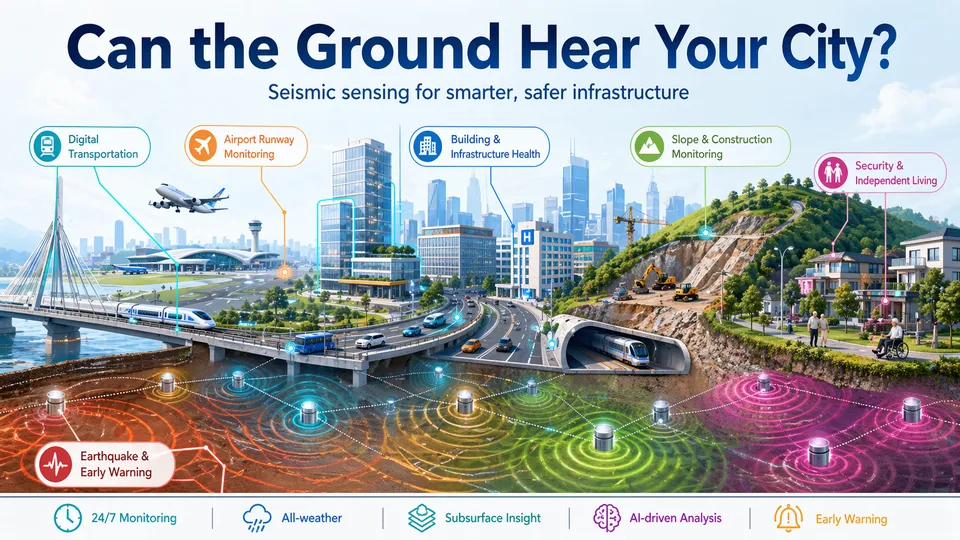
Imagine a heavy truck crossing a bridge at 3 a.m. No cameras catch it. No toll booth logs its weight. But something does notice — a small sensor buried near the base of a bridge pier, no bigger than a soda can, quietly recording the faint trembling of the ground beneath.
Not an earthquake. Just a truck. And yet, that trembling carries more information than you might think.
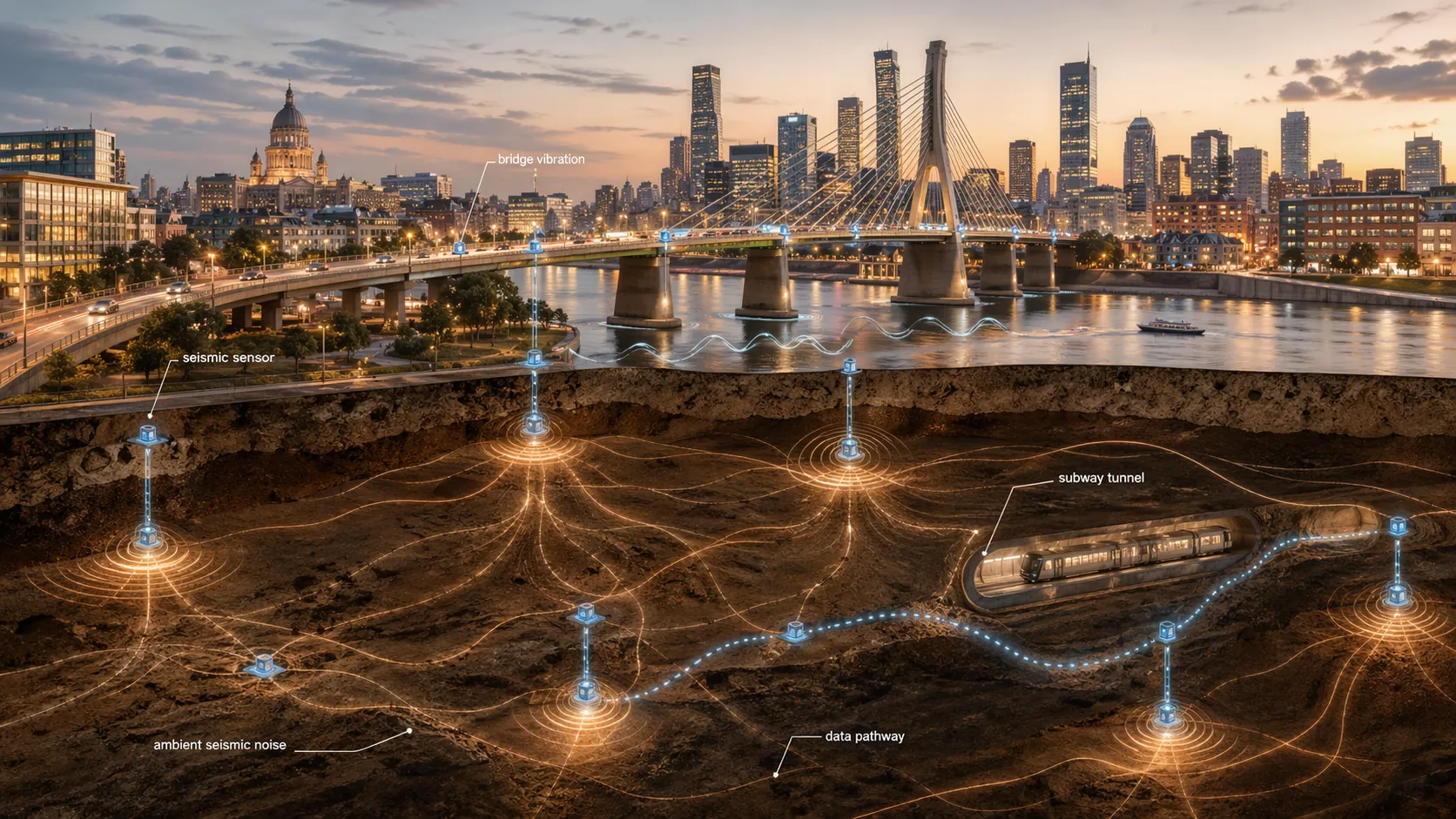
The Misunderstood Seismometer
Most people picture a seismometer as a dramatic instrument — something that spikes wildly during a catastrophe, then sits idle for years. That picture is wrong, or at least incomplete.
The ground is never truly still. Cities pulse. Trains rumble through underground tunnels. Construction rigs pound foundations. Wind loads sway towers. Even a crowd of people walking in step generates a measurable vibration in the earth beneath them. This constant, low-level shaking has a name: ambient seismic noise.
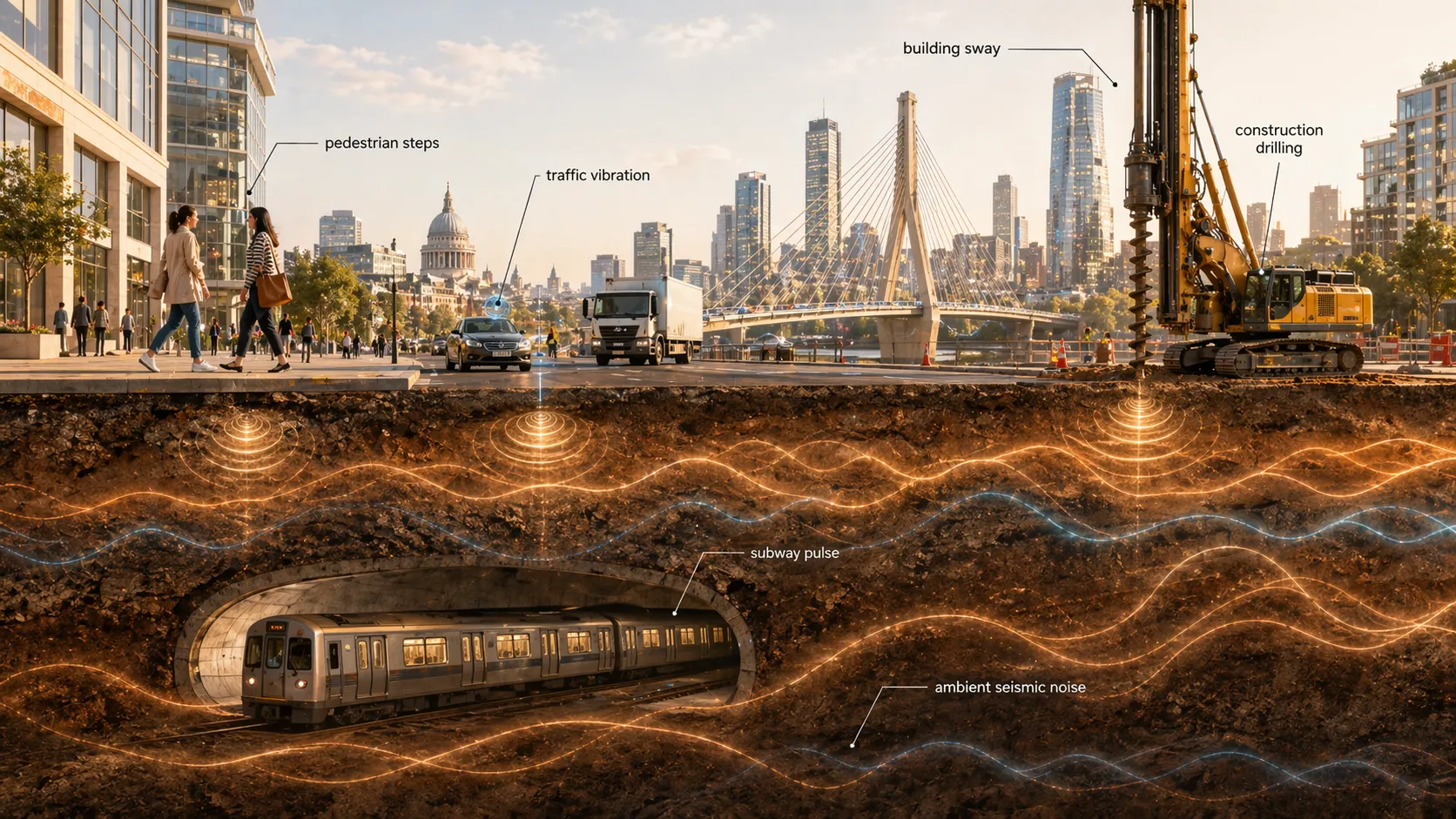
For decades, seismologists treated ambient noise as exactly that — noise. An annoying background hum to be filtered out before the “real” signal could be studied. The scientific consensus, for most of the twentieth century, was that this hum was useless.
That consensus has quietly reversed.
It turns out the noise was never meaningless. It was, in a very precise sense, the city talking.
A City Has a Vibration Fingerprint
Different activities generate vibrations at different frequencies, and each source leaves a characteristic signature in the seismic record.
Heavy freight trucks produce strong low-frequency signals — long, slow waves that travel efficiently through soil and concrete. Subway trains pulse rhythmically, their timing as regular as a heartbeat. Aircraft on runways create a particularly rich signal: a broadband burst combining rolling contact with the pavement, aerodynamic forces, and engine acoustic coupling — three physically distinct mechanisms compressed into a single event, each readable at a different frequency range. And when a structure begins to suffer internal damage — a crack propagating through concrete, corrosion weakening a steel joint — its natural resonance frequency shifts. The building, the bridge, the tunnel starts to “ring” at a slightly different pitch than it used to.
Think of it like a wine glass. A perfect crystal glass rings at a precise frequency when you tap it. A glass with a hairline fracture rings differently. You might not see the crack. But you can hear it — if you know how to listen.
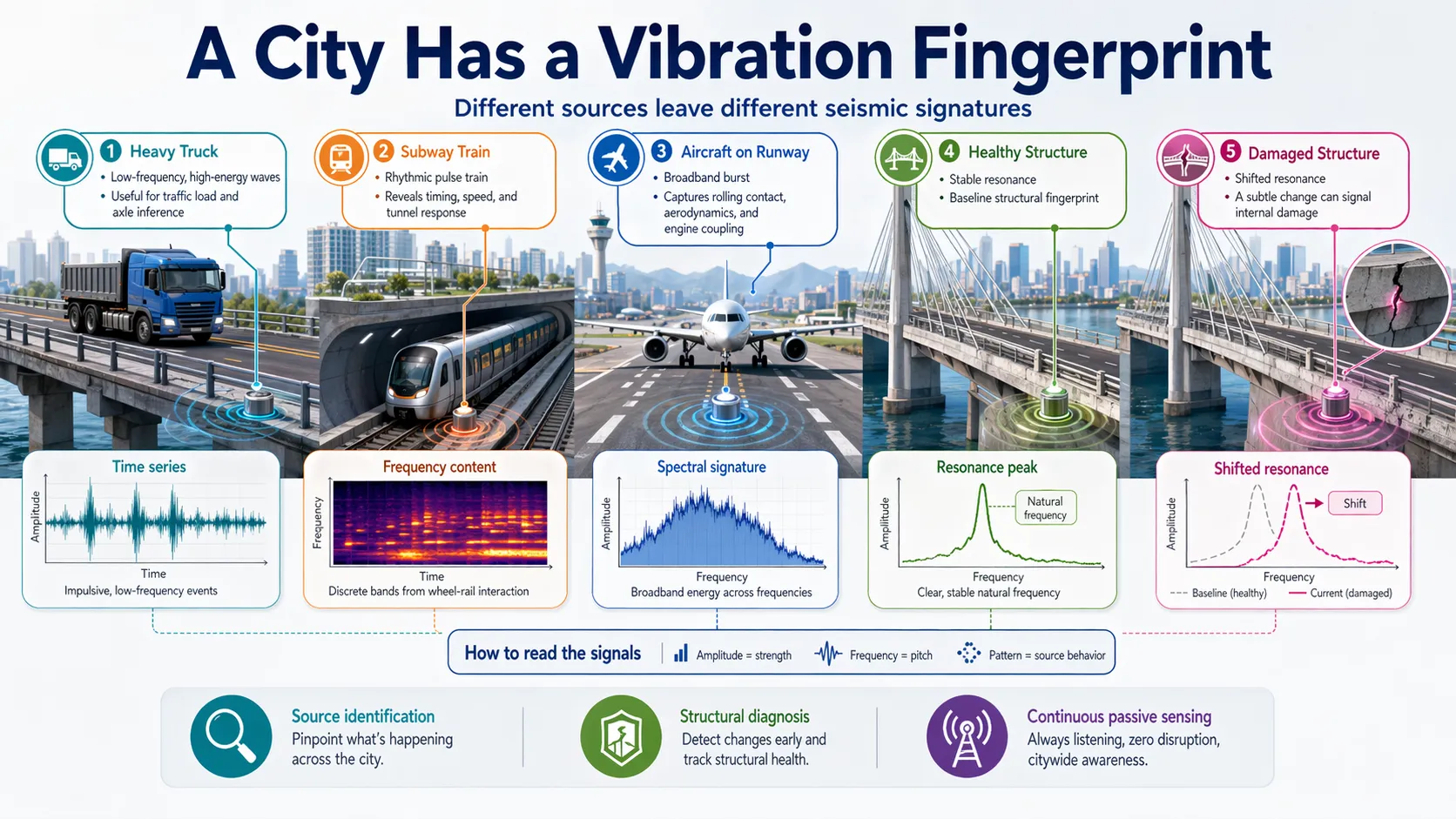
Urban infrastructure works the same way. Every bridge, tunnel, dam, and runway has a structural fingerprint: a characteristic pattern of how it responds to everyday loads. When that fingerprint changes, something has changed inside the structure. The shift may be subtle — a fraction of a hertz in resonance frequency, a small change in wave propagation speed — but it is there, measurable, and it arrives before any visible symptom does.
From Ambient Noise to Actionable Insight
Recognizing that ambient vibrations carry useful information is one thing. Actually extracting that information from a continuous, noisy, multi-source signal stream is another problem entirely — and it is where artificial intelligence enters the picture.
Consider what a dense sensor array actually records in a busy city. At any given moment, the signal contains contributions from a passing bus, a construction drill two blocks away, wind-induced sway in a nearby tower, and the ever-present microseismic background from ocean waves breaking on distant coastlines. Separating these overlapping signals is not a task for simple filters.
Modern approaches treat the problem differently. Rather than trying to subtract unwanted sources, they learn to recognize the signatures of specific sources — vehicle types, structural responses, anomalous events — directly from the raw data. The analogy to noise-canceling headphones is instructive, but inverted: instead of suppressing signal to recover silence, these systems suppress silence to recover signal.
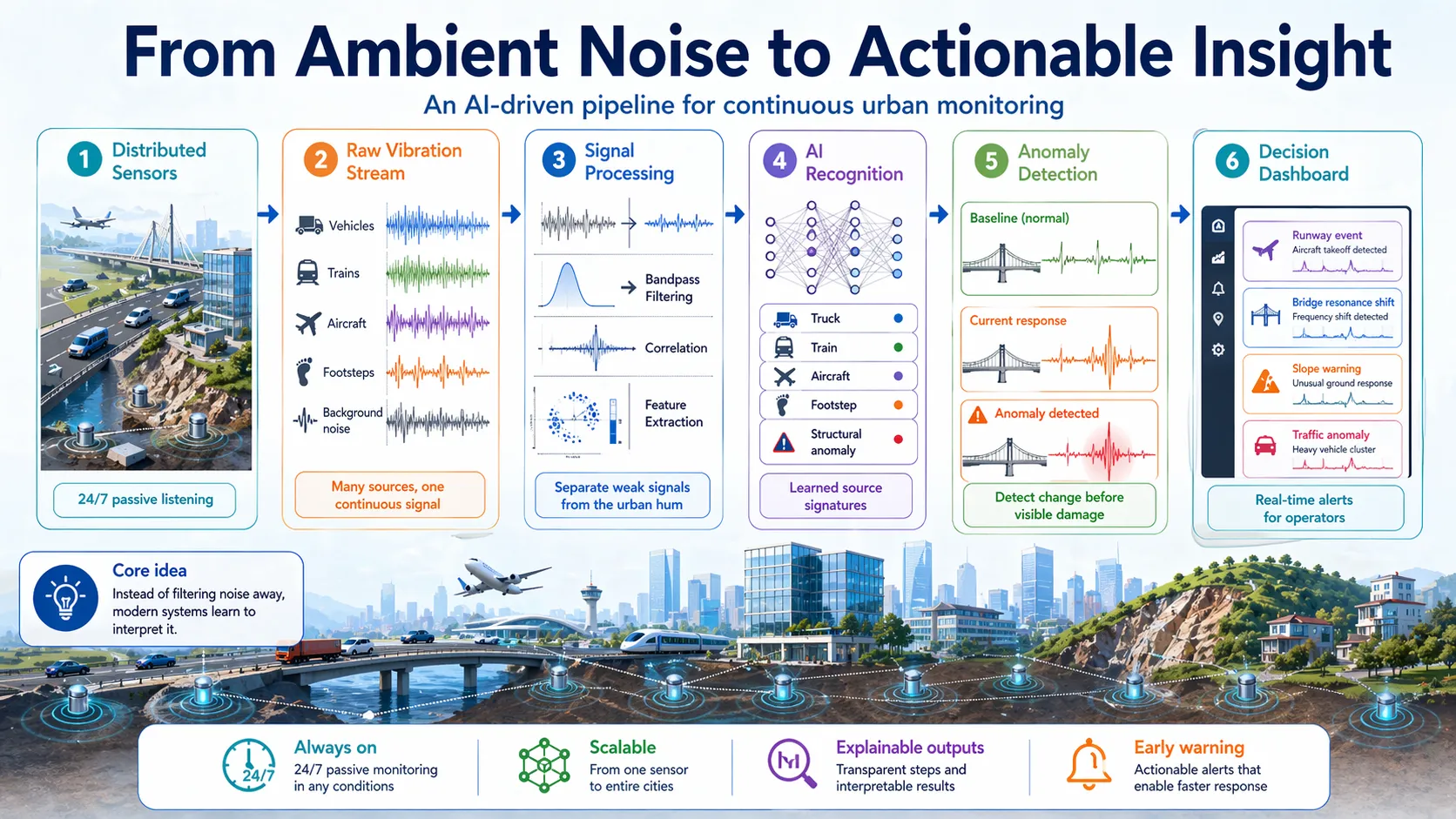
In practice, this means training machine learning models on large labeled datasets of urban vibration events, then deploying those models on continuous sensor streams in real time. A system watching a bridge doesn’t need to wait for an inspector’s visit. It is watching, always, for the moment when the bridge’s vibrational response deviates from its learned baseline.
The work of building such systems involves choices at every layer: which sensor geometries capture the most information, how to preprocess signals efficiently enough for real-time operation, how to handle the long-tailed distribution of rare but critical events. One of the more demanding deployments I have worked on involved instrumenting an airport runway environment with an array of 121 three-component seismometers — capturing aircraft operations across a frequency range broad enough to distinguish rolling contact from aerodynamic loading from engine acoustic coupling. The resulting dataset ran to hundreds of gigabytes of continuous records. Processing it in real time required both algorithmic efficiency and architectural choices that could scale.
The challenge, in the end, is not only technical. It is also human: persuading engineers, infrastructure operators, and regulatory bodies that a sensor buried in the ground — rather than a human inspector with a checklist — can be a reliable source of safety-critical information. That persuasion is, in some ways, the harder problem.
Why This Beats a Camera
The comparison to visual surveillance systems comes up often, and it is worth addressing directly.
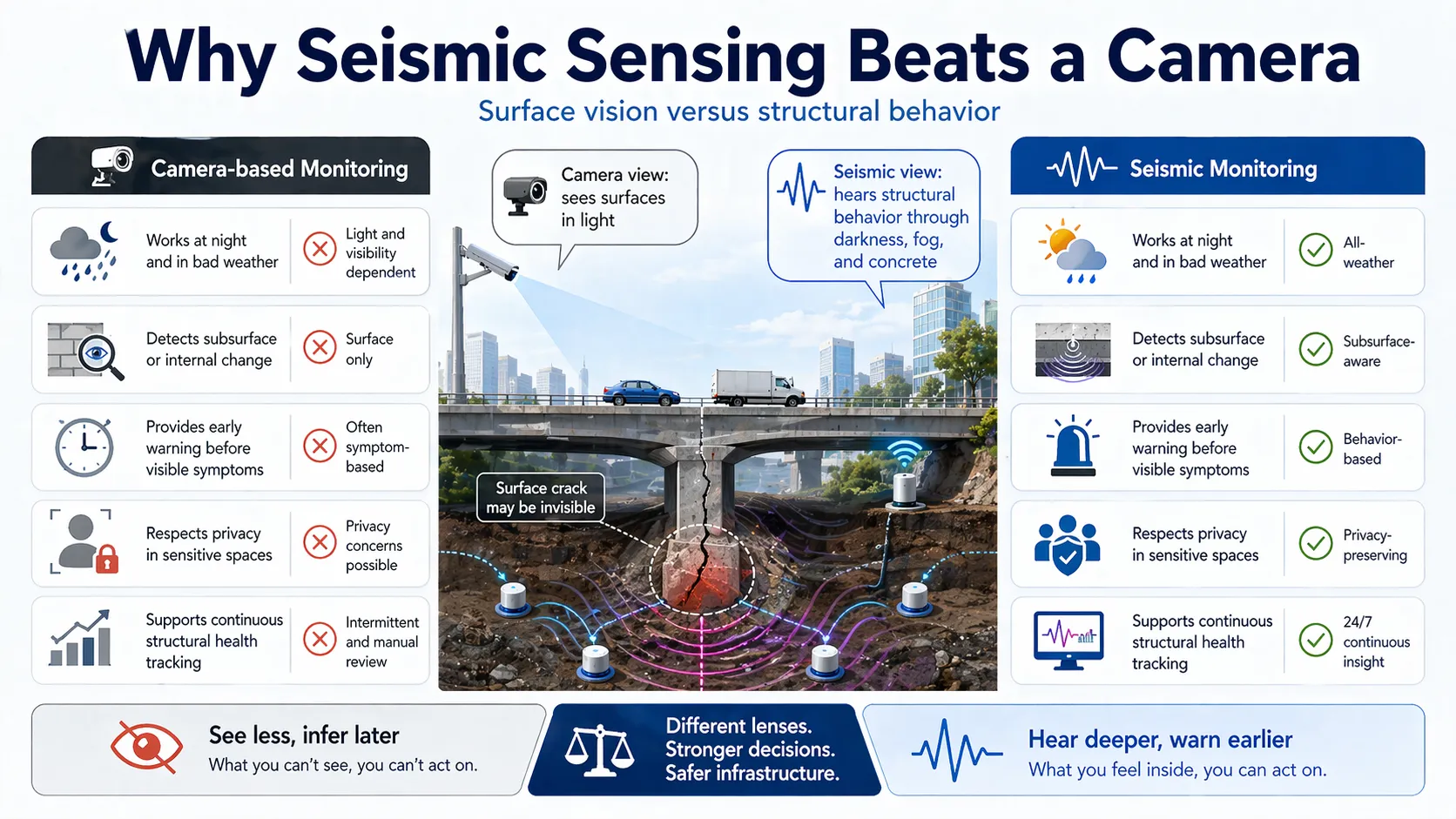
Cameras are limited to surfaces. They see what is exposed to light. They cannot see the interior of a concrete pier, the condition of rebar beneath a road surface, or the stress state of a buried pipe. They fail in darkness, fog, and heavy rain. They raise privacy concerns in residential and sensitive environments. And critically, they record symptoms — visible damage, after it has already developed — rather than precursors.
Seismic sensors have a different profile entirely. They are insensitive to lighting and weather. They work in tunnels, underwater, and inside concrete. They respond to structural behavior, not surface appearance. They are invisible to bystanders, raising no privacy issues in public or residential spaces. And because they measure how a structure moves — how it responds to the loads placed on it — they can, in principle, detect changes in structural integrity before any visible symptom appears.
This is not a hypothetical capability. Changes in the propagation speed of seismic waves through a structure — a quantity called seismic velocity — are sensitive to changes in the mechanical properties of the material. A section of concrete that has begun to delaminate, or a soil layer that has become saturated with water, will transmit seismic energy differently than it did before. The change may be subtle. But it is measurable, continuously, without anyone having to go and look.
There is something almost counterintuitive about this. The most dangerous structural changes — the ones that precede catastrophic failure — are often invisible. Fatigue, corrosion, internal cracking: these processes happen in the dark, over years, and they announce themselves through behavior before they announce themselves through appearance.
The ground has already heard about them. We just need to learn to listen.
The Urban Nervous System
The analogy I find most useful is the nervous system. A healthy body doesn’t monitor itself consciously. It maintains a continuous, low-level sensory awareness of its own state — temperature, pressure, tension — and flags anomalies for attention. It doesn’t wait for a crisis to start paying attention.
Urban infrastructure has historically lacked this property. We build structures that are, by engineering standards, extensively tested at construction time and then largely trusted to behave as designed for decades. Inspection regimes exist, but they are periodic, costly, and inevitably incomplete. A bridge inspection that takes place every two years cannot catch a failure that develops over three months.
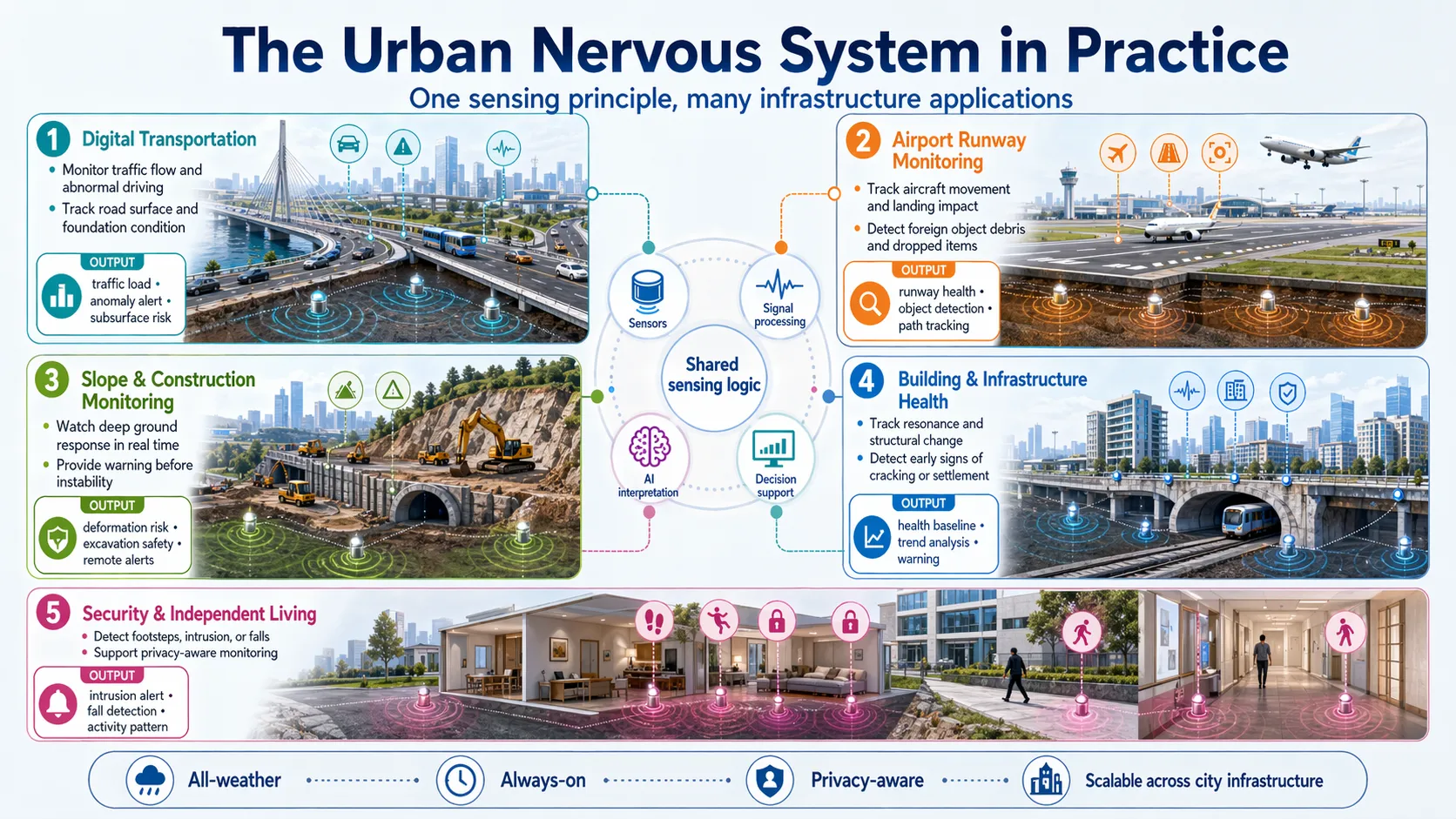
A dense, continuous seismic monitoring network changes this equation. Not by replacing engineering judgment — a sensor does not know what to do about a compromised foundation — but by ensuring that the information needed to exercise that judgment is continuously available, rather than available only when someone happens to look. And as the range of applications in the figure above suggests, the same underlying sensing principle scales from a single building to an entire city district, from runway safety to elderly care.
The vision is not science fiction. The sensor technology exists. The algorithms to process the data exist. The challenge now is integration: combining these components into systems that are robust enough for operational deployment, interpretable enough to support decision-making, and economical enough to be justified at scale.
That integration is where the interesting work is happening right now.
Listening Back
The ground has always been listening to the city. Every truck, every train, every structural shift leaves a trace in the earth’s continuous vibration record. For most of human history, we had no way to read that record — no instruments sensitive enough, no mathematics sophisticated enough, no computational power adequate to the task.
We have all three now.
The cities of the next generation will not just be built and monitored. They will be instrumented — equipped with the sensory capacity to know, in real time, something about their own structural health. The urban nervous system is not a metaphor for a distant future. It is an engineering challenge being worked on today, by teams trying to bridge the gap between what geophysics can measure and what urban infrastructure actually needs to know.
The ground is talking. We are finally learning how to listen back.
Miao YU is a geophysicist and researcher working at the intersection of seismic sensing, AI-driven signal processing, and urban infrastructure safety. Her work spans full waveform inversion theory, distributed acoustic sensing, and city-scale monitoring system deployment.